
January 19, 2026 • 4 min read
The successful transition to autonomous drilling in
open‑pit mining
The mining industry is redefining performance through automation, combining technology, safety and culture to deliver smarter operations.
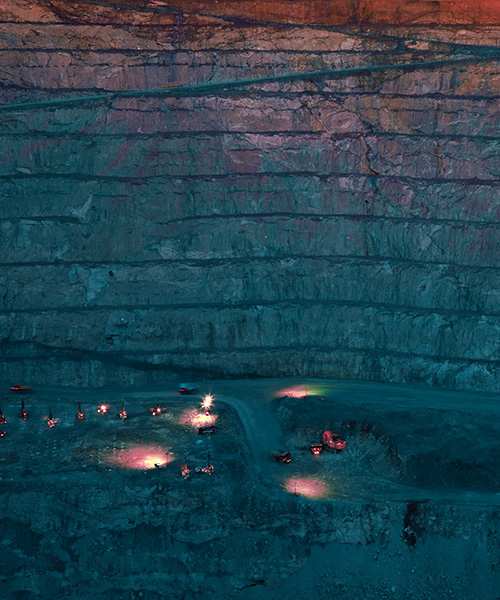
Drilling remains a cornerstone process in open-pit mining, forming the foundation for all downstream activities. As technology continues to evolve, automation is steadily finding its place in the pit, and drilling is often where that journey begins.
“The shift from conventional to autonomous drilling in surface mining represents one of the most significant technological transformations in the sector,” starts Alvaro Gonzalez, Mine Automation and Technology Lead. “It enables remote operations, improves safety, boosts productivity and consistency, providing valuable operational data. After more than a decade, Autonomous Drilling Systems (ADS) have demonstrated productivity improvements of up to 30 percent compared to manual operations, while reducing over-drilling, enabling continuous operation.”
But as Gonzalez emphasizes, “Transitioning to autonomous drilling isn’t just a technological upgrade, it’s an operational and cultural transformation.”
While conventional drilling relies heavily on the skill and judgment of onboard operators, ADS use high-precision GPS, wireless networks, and advanced software and hardware to safely execute drill plans with minimal human intervention.
Not every project, however, realizes the full benefits of ADS. Setting a framework and two parallel streams of focus are key to a successful transition.
Framework for a successful ADS transition
“Many projects involving the introduction of complex technologies fail not because of technical shortcomings, but due to insufficient organizational change,” Gonzalez explains. “Recognizing operational trade-offs between autonomous and conventional drilling is key to setting realistic expectations.”
A successful transition to autonomous drilling requires two parallel streams of focus: Implementing core technological and operational systems and proactively managing people and organizational change.
Both are essential if ADS is to achieve its full potential in safety and productivity improvements.
Implementation of core technological requirements
Before a single autonomous hole is drilled, the right technical and physical infrastructure must be in place.
“A reliable, high-bandwidth wireless network, such as LTE, is non-negotiable. It’s the backbone for low-latency data transmission between equipment and control systems,” says Gonzalez. High-precision navigation is equally vital, requiring a stable Global Navigation Satellite System (GNSS) supported by local RTK base stations for accurate hole placement.
Centralized control facilities also redefine how operations run. “In these rooms, ADS controllers oversee the fleet, monitor exceptions, and intervene remotely when required. The ergonomics, workflow, and visibility of these control rooms are critical to safe, efficient operation,” he adds.
Software integration is another essential pillar. Digital drill plans must flow seamlessly from mine planning software into the ADS, with real-time ‘as-drilled’ data feeding back into geological and operational models – closing the loop between planning and performance.
Automation also influences drill pattern design. Traditional designs must evolve to be optimized for tramming efficiency, bench stability, and repeatability. Logical, linear patterns reduce unnecessary movement, while well-prepared benches ensure safely near crests. Standardized designs simplify the autonomous workflow, enabling the system to operate with precision and consistency.
But successful automation is never just about the technology. It’s about people and processes, too.
Three pillars for proactive management of human and organizational change
“Transitioning to autonomous operations is as much about managing people as it is about deploying technology,” says Gonzalez. A superficial approach to Management of Change (MoC) is one of the primary reasons ADS projects underperform. Gonzalez points to three key pillars for a robust framework to manage change effectively.
1. Stakeholder engagement
Effective stakeholder engagement begins with open, consistent communication from project inception. Organizations need to clearly explain what is changing and why, emphasizing improvements in safety, productivity, and long-term operational sustainability. Identifying champions across all levels, from senior management to frontline operators, helps build trust, credibility and bridges communication gaps. “Equally important is creating channels for feedback,” Gonzalez notes. “When employees can ask questions, express concerns, and contribute, they’re more likely to support the transition.”
2. Workforce transition
Successful transitions require careful planning and investment in upskilling. “Conduct a skills gap analysis to assess the difference between current competencies and future operational needs across operators, maintainers, surveyors, and IT staff,” says Gonzalez. Training programs should go beyond basics of system operation to include foundations of automation principles, network systems, and GPS technology. New roles – such as fleet controllers and maintenance technicians with software and electronics expertise – need tailored learning pathways. Where available, simulator-based training can build operator confidence before engaging in live operations.
3. Process redesign
Cross-functional workshops – involving drilling, blasting, mine planning, maintenance, and health and safety teams – can help redesign workflows for autonomous operation. Updated Standard Operating Procedures (SOPs) should clearly define every aspect, from bench preparation and equipment interaction rules to emergency response protocols and data management. A phased rollout starting small and expanding as confidence grows reduces disruption. “While sometimes viewed as conservative, this ‘crawl, walk, run’ approach builds experience and minimizes risk,” says Gonzalez.
Ensuring system and functional safety
While autonomous drilling reduces human exposure to hazards, it introduces new categories of systemic risk. Functional safety ensures that the electronic and programmable systems central to ADS perform safely and reliably throughout their lifecycle.
A structured framework begins with formal hazard and risk assessments to identify potential failure modes such as unintended movements, collisions, or loss of control. Each risk is mitigated through defined safety functions. “For instance, object detection systems, emergency stop mechanisms, and geofencing that restricts drill movement to safe zones. Each function is assigned a Safety Integrity Level (SIL) corresponding to the degree of risk reduction required,” says Gonzalez.
Achieving the full potential of drilling autonomy
The transition to ADS will be a transformative milestone for the mining industry. However, challenges remain. It introduces higher initial capital costs, greater sensitivity to unpredictable geology or bench conditions, and more complex maintenance requirements.
“Success will depend as much on organizational readiness as on technical sophistication,” Gonzalez concludes. “By balancing advanced technical infrastructure with a disciplined change management framework and a rigorous functional safety governance, mining organizations can unlock the full potential of autonomy.”
The result? A safer, more consistent, and ultimately more productive drilling operation that sets a new benchmark for the future of open-pit mining.