
June 10, 2026 • 5 min read
Managing mine closure readiness and risk across the asset lifecycle
The resources industry is under growing pressure to manage risk, capital and long term liabilities more deliberately. In the current economic environment, executing sustainable mine closure only adds to complexity – introducing environmental, social and financial obligations that often extend well beyond the end of operations.
Mine closure risk doesn’t suddenly appear at the end of asset life. It builds steadily over decades.
When closure is left to the end, organizations face higher costs, tighter regulatory scrutiny, stakeholder resistance and fewer viable pathways to relinquishment.
Key takeaways
- Closure risk is fundamentally a maturity problem, not a timing problem.
- Maturity frameworks are management tools, not compliance checklists.
- Knowledge maturity and closure readiness are related – but not the same.
- Real value comes from translating maturity gaps into decisions, actions and budgets.
- Higher closure maturity protects value, credibility and future optionality.
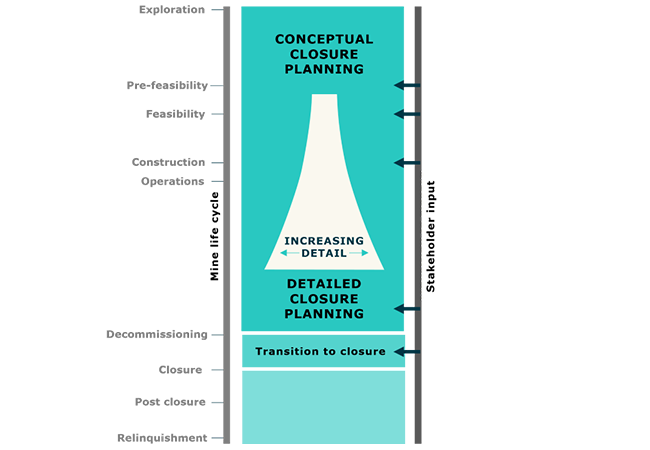
International good practice frameworks, when combined with organizational standards and regulatory requirements, can provide valuable guidance for leaders at different levels of the business. Used effectively, these tools support more informed planning and preparation for sustainable mine closure and rehabilitation.
That’s why mine closure should be managed as a business risk, not treated as a technical end of life activity.
The International Council for Mining and Metals (ICMM) developed a closure maturity framework that assists operators with closure through a series of key technical elements guiding them to assess their readiness. The framework is supported by a self‑assessment toolkit that can be used to critically evaluate operational knowledge bases and define the level of maturity as it relates to closure. Often organizational or regulatory requirements aren’t considered or incorporated into this toolkit, leaving a potential data gap. Combining the ICMM Toolkit with various organizational standards and guidelines can provide value by delivering a defendable tool that supports operations preparing for closure.
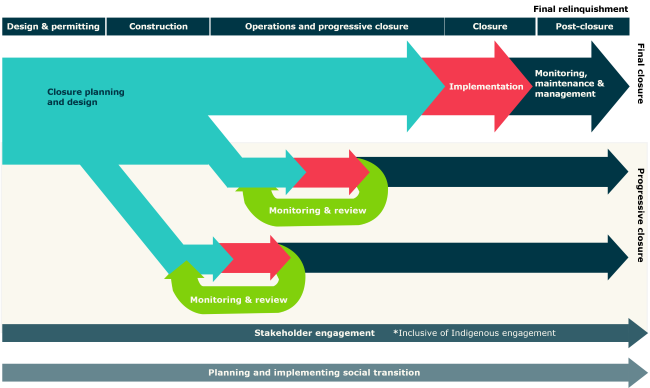
Closure risks start to build long before closure begins
Mine closure risks don’t emerge late because they're unexpected. Rather because knowledge, integration and governance mature too slowly across the life of the assets. As described by the ICMM framework, most material closure risks are systemic. This includes long term public safety and physical stability failures, persistent chemical and water liabilities and unmanaged or poorly managed social transition and stakeholder resistance. It also extends to financial under-provision and the inability to achieve or define the path to relinquishment due to unresolved risks.
The challenge isn’t producing a closure plan. It’s governing closure as a business risk throughout the life of a mine – while responding to evolving regulatory, legislative and societal expectations.
Using maturity frameworks to manage closure risk
A customized, fit-for-purpose Closure Maturity Management Tool – based on and supported by the ICMM Toolkit – provides a structured governance aid that helps organizations assess and improve how effectively closure is integrated across the life of an asset.
By benchmarking maturity across selected or pre-determined core elements – from planning and knowledge to risk, cost, execution and relinquishment – it allows leaders to identify and understand gaps early, prioritize action and progressively retire closure risk before options become constrained.
When used in this way, maturity assessment moves beyond benchmarking and becomes a mechanism for informed decision‑making.
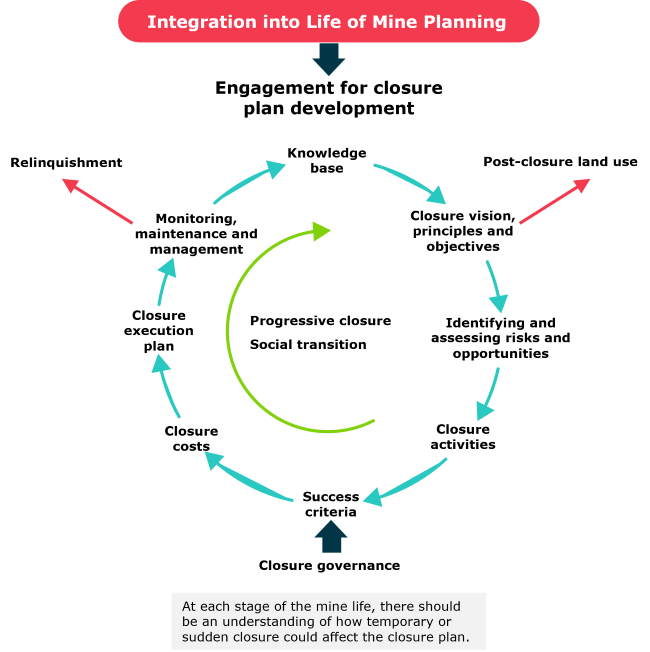
Knowledge maturity and closure readiness
Knowledge maturity underpins closure readiness by determining how confidently an operation can make and defend closure decisions while options still exist.
Within the ICMM framework, a mature knowledge base goes beyond data collection. It integrates environmental, social, technical and legal information into decision-ready models that are actively updated, tested through trials and used to manage risk, cost and stakeholder commitments across asset life.
Closure readiness emerges when knowledge is sufficiently complete, current and governed to support executable designs, creditable cost estimates, agreed success criteria and a defensible pathway to relinquishment.
At that point, closure shifts from a reactive end‑of‑life activity to a managed, evidence‑based business process aligned with responsible mine closure.
Turning maturity gaps into closure value
Closure value is realized when an organization approaches the end of an asset’s operational life with confidence, choice and control – rather than constraint.
High closure maturity transforms what was a sunk cost and residual liability into a potential source of strategic value. It helps protect licence to operate, preserve future land‑use optionality, enable credible financial provisioning and support timely relinquishment or transition.
Organizations that invest early in closure knowledge maturity, integrated planning and disciplined governance are better positioned to make defensible decisions, avoid late-stage surprises and demonstrate accountability to regulators, communities and investors alike.
Improving closure readiness at scale
In one instance, our team conducted a global review of the closure planning and preparedness maturity levels of 30 assets from concept to closure execution phases. We assessed 14 elements of the ICMM’s framework alongside the customer’s internal standards. This gave the customer a clear view of asset closure readiness against International Good Practice concepts and the degree of alignment between internal standards and ICMM guidance. Beyond preparing them for future asset and closure planning, it highlighted strengths, additional focus areas and provided a practical checklist to facilitate that process in the future.
Closure readiness isn’t just about wrapping up operations well. It’s about maximizing long-term value by ensuring what remains after mining strengthens corporate credibility, reduces legacy risk and leaves options open for future generations.
From insight to action
Mine closure maturity isn’t achieved by producing more plans. Rather by understanding where knowledge, governance and execution readiness are weakest and acting while options still exist.
Organizations that delay this assessment often discover their most material risks too late, when flexibility has diminished and liabilities have already formed.
Leaders responsible for asset stewardship, risk, environment and finance should be asking: Can our current knowledge base support defensible closure decisions, credible cost estimates and an executable pathway to relinquishment today, not just at the end of mine life?
Answering this question requires more than compliance reporting. It requires an integrated maturity and readiness lens.
| Closure planning maturity assessment tool: Scoring for system and implementation | |||||
|---|---|---|---|---|---|
| Assessment | The asset system and requirements implementation | Type of findings | Corrective actions | Score | Color code |
| Compliant (C) |
Requirement: Asset system and requirement implementation satisfy the requirement within the criteria. Accountability: Documented accountabilities exist to keep the asset in compliance with the requirement. Monitoring and improvement: Asset has processes to assess and verify compliance and to identify improvement opportunities or required changes based on performance, legislation, changes in activities, and changes in the asset risk profile. |
No finding | No action required | 100% | |
| Substantially Compliant (SC) |
Requirement status: Asset system and requirement implementation generally satisfy the requirement within the criteria. Finding: A minor issue exists that requires correction (for example, a documented system is in place but is due for review). |
Minor finding | Minor corrective actions | 90% | |
| Partially Compliant (PC) |
Requirement status: Asset has systems and practices related to the requirement but they do not directly address it, or they have not been effectively implemented. Action planning: There is evidence of existing action plans to comply with the requirement. Finding: A significant finding or multiple minor findings need to be corrected. |
Significant finding | Corrective actions required | 75% | |
| Not Compliant (NC) |
Requirement status: No system or practices exist to satisfy the requirement within the criteria. Action planning: There is no evidence of existing action plans to comply with the requirement. |
Major finding | Major corrective actions required | 50% | |
Governing closure as a business process
Mine closure challenges rarely emerge because risks were unknown. They emerge because maturity, integration and governance didn’t keep pace with the asset lifecycle. Closure maturity reframes this challenge as a leadership issue – one that requires disciplined governance, decision‑ready knowledge and early translation of insights into action. When treated this way, closure becomes a managed business process as opposed to a deferred technical obligation.
As expectations from regulators, communities and investors continue to rise, the organizations that can demonstrate credible closure readiness will stand apart.
Those with mature knowledge systems, transparent pathways to relinquishment and execution-ready plans will retain optionality, control outcomes and avoid late-stage surprises.
We support this shift by helping customers integrate closure maturity into everyday decision making. We bridge strategy and execution, align knowledge and ICMM based assessments with organizational and regulatory standards and convert maturity gaps into prioritized work programs, budgets and decision pathways. When closure thinking is embedded early and governed deliberately, responsible closure becomes a source of credibility, resilience and long term value – not an end of life scramble.
Speak to an expert today