October 06, 2026 • 4 min read
Europe’s battery moment: Moving from ambition to industrial reality
Europe is at a critical inflection point in the global battery and energy storage race. Demand for electric vehicles and grid-scale storage is accelerating rapidly, but for many developers, investors and operators, the question is: How do we deliver batteries at scale?
Despite strong demand, Europe remains structurally dependent on external supply chains for battery cells, materials refining and increasingly, technology direction.
Globally, battery demand exceeds 950 GWh annually and is moving toward the multi‑terawatt‑hour era. China dominates both cell manufacturing and critical mineral refining, and while Europe holds a modest share of capacity, much of it is foreign owned.
This imbalance creates a gap between ambition and execution that directly impacts economic exposure and strategic vulnerability in a sector central to decarbonization, mobility and energy security.
Europe has world-class research, strong engineering capability and ambitious climate policies. However, industrial‑scale execution hasn’t kept pace with global leaders like CATL, LG and Panasonic. Choices made over the next five years about coordination, scale, technology pathways and execution discipline will shape Europe’s trajectory and ultimately move the region from ambition to industrial reality.
Four futures for Europe’s battery industry
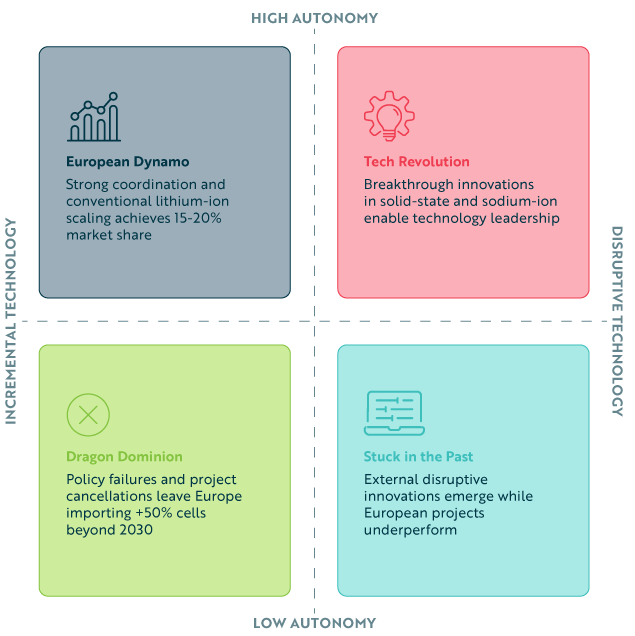
When we look at the market today, four plausible scenarios emerge when mapping technology disruption against strategic autonomy.
Dragon Dominion
Fragmented policy, canceled projects and rising dependence on imports. Europe becomes structurally reliant on external suppliers, recreating vulnerabilities and dependencies once associated with fossil fuels.
Stuck in the Past
Europe struggles to scale lithium-ion capacity while next-generation technologies mature elsewhere. Gigafactories risk becoming obsolete before reaching competitiveness, locking Europe into licensed or imported technologies.
European Dynamo
Coordinated execution. Policy clarity, stable investment frameworks and rapid scale‑up allow Europe to reach terawatt-hour (TWh) scale of annual capacity, achieving cost parity and securing most of its own demand.
Tech Revolution
The most ambitious path. Europe leads in commercializing next‑generation technologies like solid-state or sodium-ion batteries, exporting technology rather than importing it, and reshaping global supply chains in the process.
These scenarios aren’t predictions, they’re signals. Today, Europe is drifting between ambition and fragmentation, a position that delivers neither leadership nor resilience.
Europe’s battery future is being decided now.
Download our Giga Europe 2026 insights on the scenarios shaping gigafactory delivery, next‑gen chemistries, and long‑term supply security.
Europe’s future hinges on quality of execution
Europe’s bottleneck isn’t a lack of ideas, nor access to raw materials. Its main constraint is industrial scale-up: moving from pilot lines to repeatable, bankable and commercial manufacturing. Slow permitting, fragmented regulation, infrastructure constraints and shortage of experienced operators amplify execution risk and deter private capital.
From what we’re seeing across the market, these challenges are now the primary barrier to investment, not capital availability.
Capital follows clarity. Where frameworks are stable and execution risk is managed, investment mobilizes quickly. Where signals are fragmented, uncertainty prevails, and capital reallocates elsewhere.
This is why policy ambition alone is insufficient. Industrial credibility is earned through delivery.
Next-generation batteries: Optionality beats single bets
Solid-state and sodium-ion batteries are real technologies that sit on different maturity curves and serve different applications.
Solid-state offers transformational performance but faces scale‑up challenges. Sodium‑ion is nearer-term, cost‑driven and well suited to stationary storage and entry-level mobility, particularly where supply security matters more than energy density.
The strategic error isn’t choosing the ‘wrong’ technology. It’s assuming a single winner will dominate all applications. Flexibility that’s supported by informed decision‑making and manufacturing readiness matters more than single bets.
In practice, this means making informed decisions early while keeping pathways open as technologies mature.
Solid-state
50-70% higher energy density, zero fire risk, +800km EV range by 2028-2030.
Sodium-ion
20-40% cheaper than LFP, eliminates lithium/cobalt dependence, ideal for city EVs and grid storage.
Lithium-sulphur
2-3 x energy density potential, abundant sulphur feedstock, targets ultra-long range and aviation applications.
Proactive down selection for informed optionality
Reducing the pairing iterations of cathode and anode formations match market needs.
Manufacturing is where competitiveness is won or lost
Competitiveness isn’t being won by breakthroughs in laboratories. It’s being won by manufacturing innovation on the factory floor.
Advances in dry electrode processing, cell‑to‑pack architectures and AI‑enabled quality control are already improving cost, yield and energy intensity.
European gigafactories are integrating renewable energy and co‑locating recycling to meet regulatory and environmental, social and governance (ESG) requirements. At the same time, they’re working to approach cost parity with Asia in a structurally different market.
The message is clear: technology leadership without manufacturing excellence doesn’t scale.
What to watch between now and 2030
The path Europe is on will become visible well before 2030.
Delays and cancellations across gigafactory projects signal a drift toward import dependence. Rising cell imports through the late 2020s would lock in strategic vulnerability.
Conversely, credible commercialization announcements, particularly in solid state or sodium ion manufacturing, would mark a pivot toward industry leadership.
Raw material access, energy prices and policy coherence will act as early warning indicators. For investors and developers, these signals matter because they shape investment decisions long before capacity comes online.
Turning ambition into delivery
Europe still has agency, but the window is closing. For organizations progressing battery projects today, the challenge isn’t defining strategy, it’s de‑risking delivery and accelerating execution. These priorities aren’t abstract. They’re practical foundations of industrial strength.
The risk isn’t investing while others are ahead. It’s choosing not to invest and permanently forfeiting strategic optionality.
The path forward is clear but requires focus and discipline.
Scale capacity rapidly toward at least 1 TWh annually by 2030.
Secure affordable, low carbon energy for manufacturing.
Execute the Critical Raw Materials Act through mining, recycling and strategic partnerships.
Invest in research and development while protecting and industrializing intellectual property.
Build skills and enable repeatable project execution.
Maintain policy coherence across member states.
From strategy to delivery: What happens next
We’re working with customers across the battery value chain to move from concept to construction and into operations. We’re seeing first-hand where projects succeed, where they stall and what it takes to deliver at scale.
If you’re developing, investing in or scaling battery projects in Europe, now is the time to act.
Download the Giga Europe 2026 presentation to explore the scenarios in more detail, or connect with our team to discuss how you can accelerate delivery and reduce risk in your portfolio.
Speak to an expert today