November 16, 2026 • 6 min read
Four lessons from Capital Matters: Why mining projects struggle to protect full‑cycle value

Mike Placer
Mining has no shortage of technical capability. It delivers some of the world's biggest and most complex capital assets. But consistent project performance remains an industry-wide challenge.
“Too many projects drift away from the business case, miss schedule commitments or lose the predictability investors and owners need,” says Mike Placer, Sector Lead for Mining Americas.
“Projects that miss cost, schedule, and value targets are not isolated exceptions. They have become a persistent industry challenge.” Reflecting this concern, EY ranked capital as the number one business risk and opportunity facing mining and metals companies in 2025, and it remained as a top three in their 2026, and 2027 reports.
With miners under pressure to supply the materials the world needs, the industry must rethink how projects are planned, contracted, governed and improved.
The uncomfortable truth
“Mining projects aren’t consistently delivering the value they once did,” says Placer.
“The industry has a good reputation for sanctioning the right business cases but regularly fails to achieve their desired value. Whether it’s by missing cost and schedule commitments or underestimating the role that communities, employees, governments and other stakeholders play in achieving successful outcomes.”
“We must act by changing how projects are defined, governed, contracted, and delivered before more capital is lost and confidence erodes further.”
Compared with sectors such as manufacturing, pharmaceuticals, aerospace and oil and gas, mining continues to underperform. Complexity plays a role but doesn’t fully explain this gap. Limited standardization, fragmented delivery models and underinvestment in project management and digital capability make good projects harder to deliver.
“Projects are often large, technically complex, and exposed to factors outside an owner’s control. Ore bodies are becoming more challenging, commodity prices shift and permitting can take years.”
But these realities don’t fully explain the gap.
“The industry still faces challenges such as limited standardization, fragmented delivery models, and years of underinvestment in project management and digital capability, all of which make good projects harder to deliver.”
“Mining still treats many projects as one-offs, rebuilding processes and reworking solutions that other industries standardized years ago. That comes at a cost.”
“No single party can fix this,” Placer adds. “Not the owners, not the OEMs, not engineering. The issue is structural.”
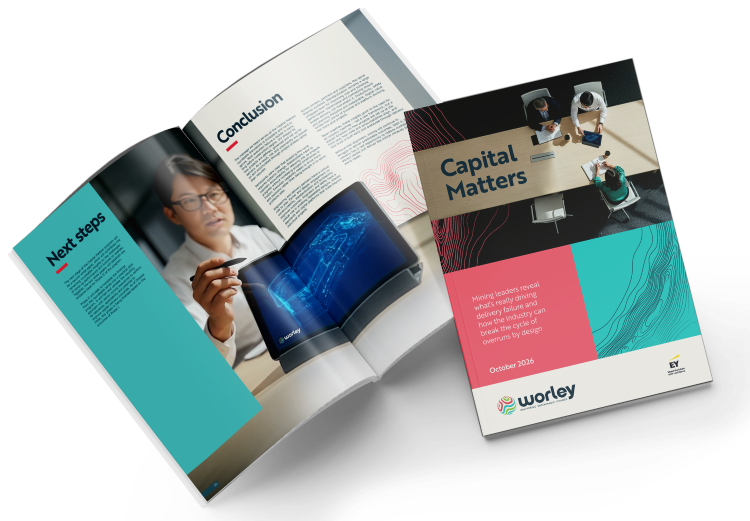
Recently, mining leaders have come together through Capital Matters to talk honestly about what isn’t working, where value leaks away and what must change so capital can move with more confidence.
Here’s what we found.
The certainty trap
Mining lives with uncertainty from day one. Geological models are estimates, ore characteristics vary, hardness shifts and recoveries move.
“Even the best engineering will be tested once a project meets real operating conditions,” says Placer. “So why are we so determined to hard-design plants around a fixed answer when we know technological change is one of the few certainties the industry can count on?”
The industry has an opportunity to design for intelligence, rather than uncertainty. Better data, connectivity and predictive analytics can reduce over‑engineering while improving operational performance.
“The competitive advantage will belong not only to those who maximize standardization, but to those who combine standardization with adaptive, data-driven operations that continuously optimize the asset throughout its life.”
Today’s capital environment often values early precision over long-term adaptability. Funding models prefer clear numbers and fixed scope, and contracting frameworks penalize change.
“Projects are still locking-in early, committing to large, complex solutions sooner than they should, not always because they’re the best answer, but because they’re easier to finance and easier to contract.”
“Inflexibility isn’t just a technical outcome. It’s also a sign that governance and commercial models need to catch up.”
The issue is rarely engineering capability alone. It’s whether the project model continues to test assumptions, adapts to new information and protects full-cycle value as the asset moves from design through commissioning and into operation.
When projects stop being investments and start becoming spend
“Capital projects exist to create value. But the further a project moves into execution, the easier it is for that value to fade from view, or in some cases, it morphs into a financial formula that oversimplifies the definition of value,” says Placer.
Projects are usually approved on the strength of a business case built around long-term value. “But once they’re sanctioned, the conversation often shifts to budget control, approvals and keeping momentum, even when those decisions weaken value over the life of the asset.”
What gets measured and rewarded during execution can start to pull a project away from the value it was originally meant to deliver.
“This is about accountability and disciplined value definition.”
As a project moves from FEL1 through FEL2, FEL3 and ultimately FID, it becomes progressively harder to challenge assumptions because every gate creates momentum and commitments.
That is why expertise, governance and approaches such as minimum viable solutions (MVS) must be brought in early, when the project is still fluid and the business case can still be shaped.
“In most cases, the answer should be to deliver what was approved. In a limited number of exceptional cases, the responsible decision may be to adjust course, so the asset still protects or improves long-term value,” adds Placer.
“Design and execution choices need to be tested against full-cycle value, not just immediate cost or net present value (NPV) in isolation. NPV matters, but it isn’t the whole answer.”
That means protecting strategic flexibility, operational resilience, technology adaptability, stakeholder confidence and long-term asset performance.
Innovation versus obsolescence
Mining is right to be cautious. But caution becomes a risk when project organizations aren’t accountable for tracking technological change from FEL through commissioning.
In a sector where design-to-operation timelines can stretch for years, failing to reassess technology choices can lock projects into solutions that are outdated before the asset is running.
“We need to carefully weigh the tradeoffs of leveraging proven versus new technologies.”
“Locking in untested technologies is a risk but so is locking in a design that’s already becoming outdated,” says Placer.
Technologies pushed aside early to avoid perceived risk or complexity can return years later as costly, inflexible retrofits. A better path is to create learning earlier and keep options open for longer through testing, comparison of alternatives, and an MVS approach.
“The point isn’t to chase novelty. It’s to make better decisions before the cost of change becomes too high.”
When schedule becomes the strategy
Every project reaches a point where momentum takes over. “Construction ramps up. Money is going out the door. The pressure to keep moving gets stronger,” says Placer. “On paper, decision authority still looks clear. In practice, this is often when governance starts to drift.”
Schedules can become the main test of success. Teams become less willing to share hard truths. The original reasons for investing in the project slip into the background.
“Work continues because slowing down feels harder than pushing ahead.”
“The business case must remain the anchor throughout delivery, with governance protecting the broader value the project was intended to create,” explains Placer.
Projects need to be governed against their strategic, operational, social, commercial and long-term asset value.
“They need real opportunities to pause and reassess direction, not as a failure, but as a sign of strong governance,” says Placer.
“Without that, projects can start to look successful simply because they are moving. However, the danger is you can end up completing an asset that’s technically finished, commercially expensive and strategically underwhelming.”
What Capital Matters is calling for
Two structural issues sit behind many of these challenges: fragmented accountability and lost learning.
“Mining has no shortage of lessons from past projects. The problem is that too many of them stay buried in systems, scattered across teams or locked in people’s heads,” says Placer. “As people move on, organizations lose visibility of what worked, what failed, and why.
“New projects end up relearning old lessons at a very high price.”
“Mining doesn’t need another incremental improvement program. It needs a dramatic change in how projects are framed, governed, and delivered. We must stop treating capital projects as approved spend to be controlled and start managing them as value investments to be protected from concept through operation,” says Placer.
“That is how the industry earns back confidence and delivers the projects the future requires.”
Our first Capital Matters paper brings together industry perspectives from executive roundtables at Resourcing Tomorrow, Future Minerals Forum and PDAC to identify what’s holding back project performance and what needs to change.